
Stove Thermostat Repair Colorado Springs
Oven running too hot, too cold, or cycling erratically? Our certified technicians calibrate and repair stove thermostats for accurate cooking at Colorado Springs altitude.
⭐⭐⭐⭐⭐ 100+ Reviews | 100% Satisfied Clients | Licensed & Certified | Serving Since 2020
Why Is My Stove Thermostat Not Working Correctly?
A faulty stove thermostat is one of the most frustrating appliance problems because it makes every recipe unpredictable. The thermostat controls when your oven heats and when it cycles off, maintaining the temperature you set. When it fails, your oven may overshoot by 50°F or more, undershoot and never reach the set temperature, or cycle on and off too frequently.
In Colorado Springs, thermostat accuracy matters even more than at sea level. At 6,035 feet, the lower boiling point of water (approximately 201°F) and reduced atmospheric pressure change cooking dynamics. A thermostat that’s off by 25°F at sea level causes minor inconvenience — at our altitude, that same error can mean the difference between properly risen bread and a dense, collapsed loaf.
Our technicians use independent thermocouple probes to measure actual oven temperature against the thermostat setting, diagnose the root cause, and either recalibrate or replace the thermostat for precise temperature control.
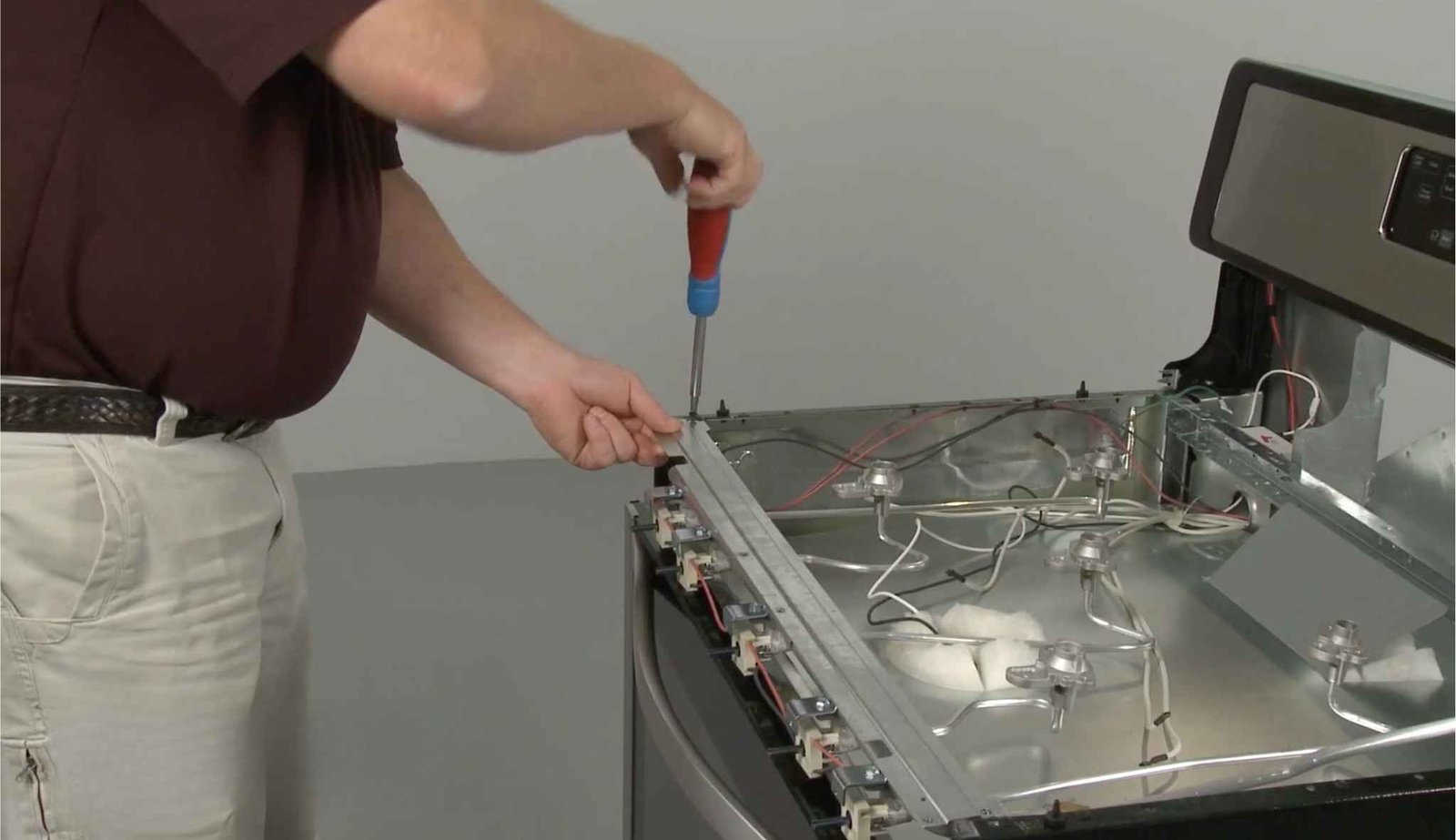
What Are Signs of a Bad Stove Thermostat?
These symptoms indicate your stove thermostat needs professional attention:
- Food burns consistently — The oven runs hotter than the set temperature, overcooking everything regardless of timing adjustments
- Food is undercooked at recommended times — The oven never reaches or maintains the target temperature
- Temperature swings wildly — The oven alternates between too hot and too cold instead of maintaining a steady temperature
- Oven won’t turn off — The thermostat fails to signal the heating element or gas valve to stop, creating an overheating safety hazard
- Oven doesn’t heat at all — The thermostat doesn’t send the “call for heat” signal, keeping the oven cold despite being turned on
- Temperature knob feels loose or grinds — Physical damage to the thermostat shaft affects the mechanical connection to the temperature sensor
Precision Thermostat Calibration for Colorado Springs Altitude
Every thermostat repair includes multi-point temperature verification with independent thermocouple probes.
How Much Does Stove Thermostat Repair Cost in Colorado Springs?
Stove thermostat repair in Colorado Springs typically costs between market rate (quoted before work begins):
- Thermostat recalibration — market rate (quoted before work begins), when the existing thermostat is functional but reading inaccurately
- Temperature sensor replacement — market rate (quoted before work begins), for failed or drifting RTD (resistance temperature detector) sensors
- Mechanical thermostat replacement — market rate (quoted before work begins), common in older ranges with capillary-tube style thermostats
- Electronic thermostat/control board — market rate (quoted before work begins), for digital ranges where the thermostat function is integrated into the control board
We quote the exact repair cost after diagnosis — before any work begins.
“My oven was burning everything. I kept lowering the temperature but cookies still came out charred. The technician found the thermostat was reading 45 degrees low — so when I set 350, it was actually hitting 395. Recalibrated it perfectly.”
— Sarah P., Broadmoor (80906)
How Does Altitude Affect Stove Thermostat Performance?
At Colorado Springs elevation, thermostat accuracy becomes critical for successful cooking. The lower atmospheric pressure at 6,035 feet affects food chemistry in ways that amplify even small temperature errors. Baked goods require precise temperature because leavening agents expand more aggressively at altitude — a thermostat running 25°F too hot causes over-expansion followed by collapse, while 25°F too cold prevents proper rise.
Gas oven thermostats at altitude also face a secondary challenge: the reduced oxygen density affects combustion efficiency, which can cause the oven to cycle differently than designed. Our technicians verify both the thermostat’s accuracy and the burner’s heat output to ensure they work together properly at altitude.
Types of Stove Thermostats We Repair
- Capillary tube thermostats — Found in older and mid-range stoves; a fluid-filled tube expands and contracts with temperature changes to open and close the gas valve or electrical contacts
- RTD temperature sensors — Modern electronic sensors that change electrical resistance as temperature changes; send data to the control board for precise digital temperature management
- Thermocouple-based systems — Safety devices that detect flame presence; while not a thermostat per se, a failing thermocouple affects oven heating behavior
- Integrated electronic controls — In modern ranges, the thermostat function is built into the main control board; failure requires board-level diagnosis
“We couldn’t figure out why our bread kept failing at altitude. Turns out the oven thermostat was 30 degrees off. After the repair and calibration, our baking is perfect. Worth every penny.”
— Karen H., Black Forest (80908)
Stove Thermostat Repair: (719) 467-3100
Frequently Asked Questions About Stove Thermostat Repair
How can I test if my oven thermostat is accurate?
Place an oven-safe thermometer in the center of your oven, set it to 350°F, and let it preheat for 20 minutes. If the thermometer reads more than 25°F above or below 350°F, your thermostat likely needs calibration or replacement.
Can a stove thermostat be recalibrated or does it need replacing?
Many thermostats can be recalibrated if the drift is within a correctable range (typically up to 50°F). Beyond that range, or if the thermostat has physical damage, replacement is necessary.
Why does my oven temperature fluctuate so much?
All ovens cycle between heating and resting to maintain temperature. Normal cycling creates a ±10–15°F swing. If the swing exceeds 25°F, the thermostat’s hysteresis range is too wide and needs adjustment or replacement.