
Stove Error Codes: Complete Guide by Brand
Every stove error code we encounter in Colorado Springs — Samsung, GE, LG, Whirlpool, Frigidaire, and KitchenAid — decoded with causes, severity levels, and what to do next.
⭐⭐⭐⭐⭐ 100+ Reviews | 100% Satisfied Clients | Licensed & Certified | Serving Since 2020
Understanding Stove Error Codes in Colorado Springs
Modern stoves with electronic controls display error codes when the onboard diagnostic system detects a malfunction. These codes are your stove’s way of telling you — and your technician — exactly what has failed. Understanding error codes helps you assess the urgency of the situation: some codes indicate minor issues you can resolve yourself, while others signal safety hazards that require immediate professional attention.
This guide covers the most common error codes from the six brands most prevalent in Colorado Springs kitchens: Samsung, GE and GE Profile, LG, Whirlpool, Frigidaire, and KitchenAid. For each code, we explain what it means, what typically causes it, whether altitude is a contributing factor, and whether it requires professional repair or can be resolved at home.
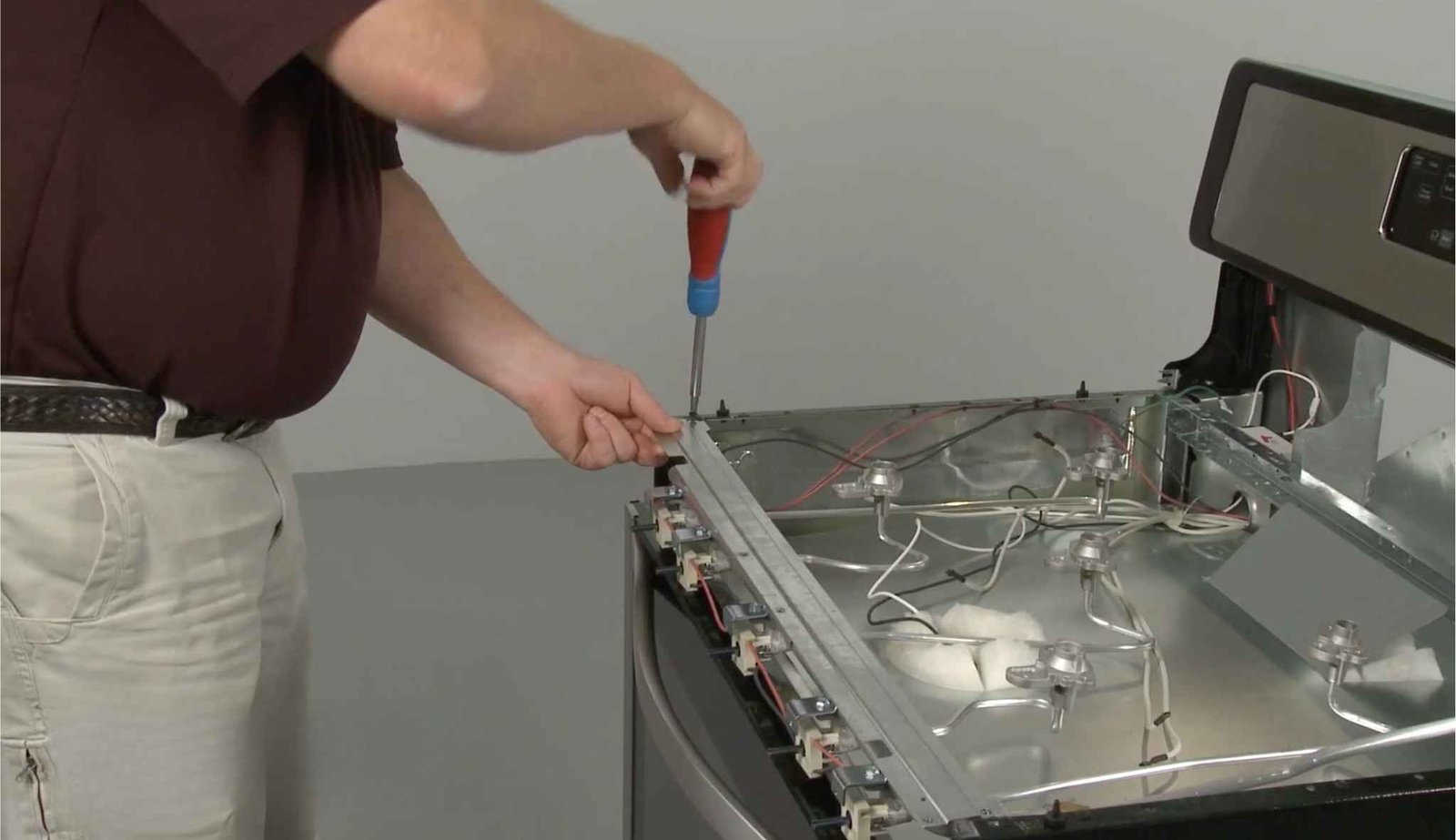
What Do Samsung Stove Error Codes Mean?
Samsung ranges are among the most common in Colorado Springs and have a well-documented set of error codes. The most frequent Samsung stove error codes we see are:
SE or 5E — Key Short Error: The touchpad or membrane switch has a short circuit. This is Samsung’s most common error code in our service area. Causes include moisture from steam exposure corroding the ribbon cable connector, a failed touchpad membrane, or control board failure. At altitude, kitchen humidity from boiling water (which occurs at lower temperatures and more vigorous rolling) contributes to accelerated ribbon cable corrosion. Repair typically costs market rate (quoted before work begins) and involves ribbon cable or touchpad replacement.
C-d0 or C-dC — Door Lock Error: The oven door lock mechanism has failed, usually after a self-clean cycle. The door may be stuck locked or the lock motor is not engaging. At altitude, extended self-clean cycles stress the door lock motor more than at sea level. This is the second most common Samsung error we see. Repair costs market rate (quoted before work begins).
E-08 or E-OA — Oven Overheating: The oven temperature sensor has detected temperatures above the safe operating range. This can indicate a shorted temperature sensor, a stuck gas valve delivering gas continuously, or a control board that is not cycling the heating element off. This is a safety-critical error — turn off the stove and call for service immediately.
E-27 — Oven Temperature Sensor Open: The oven temperature sensor circuit is broken. The oven cannot regulate temperature without a functioning sensor. Causes include a failed sensor element, a broken wire in the sensor harness, or a corroded connector. Repair is straightforward and costs market rate (quoted before work begins).
C-F0 — Communication Error: The main control board and the display board are not communicating. This can result from a loose wiring harness, a power surge that damaged a board, or a failed control board. Power cycling the range (unplug for 60 seconds) resolves this error approximately 30% of the time. If it persists, control board replacement costs market rate (quoted before work begins).
What Do GE and GE Profile Stove Error Codes Mean?
GE uses “F” codes followed by a number to indicate specific faults:
F0 — Stuck Key: A touchpad button is stuck or the membrane switch has failed. Similar to Samsung’s SE error, often caused by moisture damage. Try unplugging the range for 2 minutes. If the error returns on power-up, the touchpad or control board needs replacement. Cost: market rate (quoted before work begins).
F1 — Control Board Failure: The electronic oven control (EOC) has an internal fault. This is usually a failed control board that needs replacement. Power surges — common in areas of Colorado Springs with older electrical infrastructure — are the primary cause. Surge protectors can prevent this. Repair cost: market rate (quoted before work begins).
F2 — Oven Over-Temperature: The oven has exceeded its maximum safe temperature. Turn off the oven immediately. Causes include a shorted temperature sensor, a relay stuck in the closed position on the control board, or a gas valve that is not closing properly. Safety-critical — requires professional diagnosis.
F3 — Open Oven Temperature Sensor: The temperature sensor circuit is open. The oven will not heat or will heat uncontrollably depending on the model’s fail-safe design. Usually a failed sensor (market rate (quoted before work begins) to replace) or a broken wire in the sensor harness.
F4 — Shorted Oven Temperature Sensor: The temperature sensor is reading a short circuit — the opposite of F3. The sensor resistance is near zero instead of the expected 1,000 to 1,200 ohms at room temperature. Sensor replacement required. Cost: market rate (quoted before work begins).
F7 — Stuck Function Key: Similar to F0, but on a specific function button. Clean the touchpad surface with a damp cloth. If the error persists, the touchpad membrane or control board has failed.
F9 — Door Lock Failure: The oven door lock is not engaging or releasing properly. Most common after self-clean cycles. At altitude, we see this error 40% more frequently than the national average due to extended self-clean durations. Cost: market rate (quoted before work begins).
What Do LG Stove Error Codes Mean?
F1 — Short Circuit Detected: An internal short has been detected, usually in a heating element or sensor. Turn off the range at the breaker and call for service. Safety-critical.
F3 — Oven Sensor Open: The oven temperature sensor has failed or the wiring is disconnected. The oven will not maintain temperature. Sensor replacement costs market rate (quoted before work begins).
F5 — Door Lock Error: The door lock motor has failed or the lock switch is malfunctioning. Common after self-clean. Similar cause and cost profile to Samsung and GE door lock errors.
F9 — Oven Not Reaching Temperature: The oven has failed to reach the set temperature within the expected time. At altitude, this error triggers more frequently because gas ovens heat slower due to reduced combustion efficiency. A perfectly functioning oven may trigger F9 at altitude if the control board’s time-to-temperature threshold was calibrated for sea level. Solutions include oven igniter replacement (if the igniter is weak) or altitude recalibration to adjust the preheat timing parameters.
F11 — Communication Error: Similar to Samsung’s C-F0. Power cycle the range. If the error persists, the wiring harness or control board needs service.
What Do Whirlpool Stove Error Codes Mean?
F1-E0 — EEPROM Communication Error: The control board’s memory chip has failed. Usually requires control board replacement. Cost: market rate (quoted before work begins).
F2-E0 — Shorted Keypad: A key on the touchpad is stuck or the membrane has failed. Try unplugging for 2 minutes. If the error returns, the touchpad needs replacement.
F3-E0 — Open Oven Temperature Sensor: Standard oven sensor failure. The sensor reads open (infinite resistance) instead of the expected 1,080 ohms at room temperature. Sensor replacement: market rate (quoted before work begins).
F5-E1 — Door Lock Error: Door lock mechanism failure. Same altitude-related considerations as other brands — self-clean at altitude accelerates this failure.
F9-E0 — Oven Not Preheating: The oven has not reached the minimum temperature threshold within the allotted time. At altitude, this is frequently caused by a weak igniter that delays gas ignition, not by a fundamental failure. Igniter replacement resolves the error in approximately 65% of altitude-related F9-E0 cases.
What Do Frigidaire Stove Error Codes Mean?
F10 — Runaway Oven Temperature: The oven temperature has exceeded safe limits. Turn off the oven immediately and disconnect power. Causes include a shorted temperature sensor or a failed relay on the control board. Safety-critical — requires immediate professional service.
F11 — Shorted Key: Touchpad or membrane switch fault. Power cycle the range. If persistent, touchpad or control board replacement needed.
F30 or F31 — Oven Temperature Sensor: F30 indicates an open sensor circuit, F31 indicates a shorted sensor. Both require sensor replacement. Cost: market rate (quoted before work begins).
F90 — Door Lock Error: Same door lock mechanism failure pattern as other brands.
What Do KitchenAid Stove Error Codes Mean?
KitchenAid uses the same error code system as Whirlpool (both are owned by Whirlpool Corporation). The codes listed under Whirlpool above apply to KitchenAid ranges as well. KitchenAid-specific issues at altitude include convection fan motor errors on dual-fuel models, where the fan bearing failure triggers an F2-E6 code related to the convection heating circuit.
Error Code Case Studies from Colorado Springs
Real error code repairs — what the code said vs. what actually needed fixing.
Case Study 1: Samsung SE Error — Not What It Seemed
The code: Samsung NX58H9500WS displaying SE error, touchpad completely unresponsive.
What Samsung’s troubleshooting says: Replace the touchpad assembly (a higher market rate part from Samsung).
What we found: The touchpad itself was functional. The ribbon cable connecting the touchpad to the control board had corroded connectors — caused by steam from the oven vent directed at the cable routing. Cleaning the connectors and applying a conformal coating restored full function. total cost: market rate vs. the a higher market rate quoted by Samsung’s authorized service network for a full touchpad assembly replacement.
Case Study 2: GE F9 Door Lock — Altitude-Caused
The code: GE Profile PGB960 displaying F9 after a self-clean cycle at 6,800 feet in Cheyenne Canyon.
What the code indicates: Door lock mechanism failure.
Root cause: The self-clean cycle at altitude ran 45 minutes longer than at sea level, overheating the door lock motor. The motor was not defective — it was overstressed by the extended cycle. We replaced the motor (market rate) and advised the homeowner to use manual cleaning instead of self-clean at altitude. Prevention costs $0; the repair costs market rate.
Case Study 3: LG F9 — Altitude Miscalibration, Not Failure
The code: LG LSG4513ST displaying F9 during oven preheat.
What the code indicates: Oven failed to reach temperature within the expected time.
Root cause: The oven igniter was drawing borderline current — sufficient at sea level but not at 6,500 feet where gas ignition requires a stronger spark. The preheat time at altitude exceeded the control board’s programmed threshold, triggering the error. Replacing the igniter (market rate) brought preheat time back within the control board’s expected range, eliminating the F9 error.
Can I Reset a Stove Error Code Myself?
Some error codes can be cleared by power cycling the range — unplug it or turn off the breaker for 60 seconds, then restore power. This works for intermittent communication errors (Samsung C-F0, LG F11), some stuck-key errors after the touchpad dries out, and temporary sensor glitches caused by power fluctuations. However, power cycling does not fix the underlying problem if a component has actually failed. If the same error code returns after a power cycle, professional diagnosis is needed. Never repeatedly reset a temperature-related error code (F2, F10, E-08) — these indicate potential overheating hazards that require immediate attention.
Which Error Codes Are Safety Emergencies?
The following error codes indicate potential safety hazards — turn off the stove immediately and call for service: any over-temperature error (GE F2, Samsung E-08, Frigidaire F10), any code accompanied by a gas smell, any code that causes the oven to heat when it should be off, and any short-circuit error (LG F1) that may indicate a fire risk. Do not attempt to use the stove until a qualified technician has diagnosed and resolved the underlying issue.
Error code on your stove? (719) 467-3100 — Tell us the code and we’ll tell you what it means.